

W3C
Organisation developing open standards used to build the web.
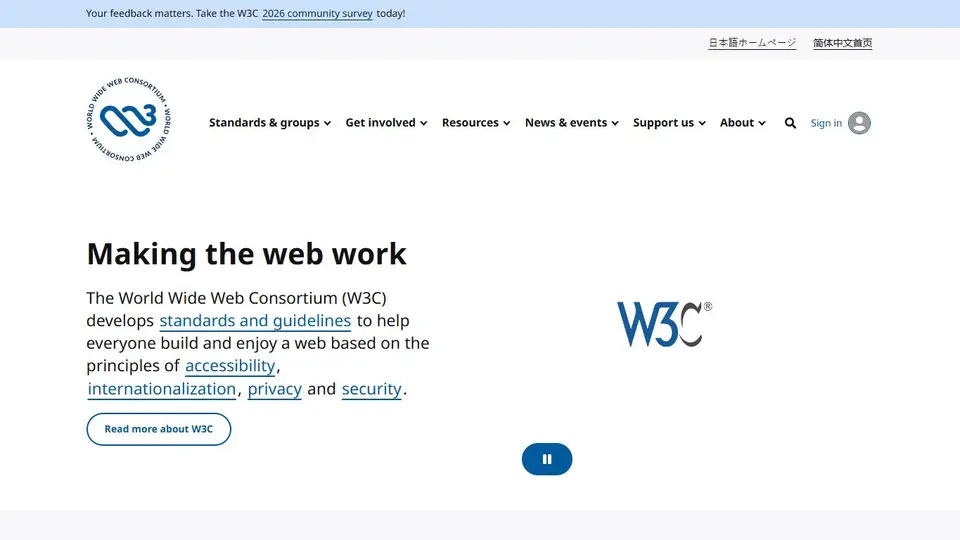
Screenshot captured on an unrecorded date. The current website may have changed.
Locate a web specification
Identify the standard, version and publication status before quoting a requirement.
Check first: A working draft and a published recommendation have different stability.

Compare this resource with other directory records →
Distinguish standard, draft and learning resource
W3C publishes web specifications and recommendations, alongside accessibility and internationalisation resources. Hosting on w3.org does not automatically make a document a Recommendation. Record status, date and exact version for technical references.
- Status
- Read the document’s opening status section.
- Reference
- Keep the dated version address.
- Version to cite
- Keep the dated version URL, displayed status and latest-version link: these serve different purposes.
- Group Note
- A Group Note supplies a stable reference for a document not intended to become a formal standard. It does not have the standing of a W3C Recommendation.
Source: W3C — Process, Group Notes · consulted on - Guidance and requirements
- Design explanations, use cases and non-normative good-practice guides may be published as Notes. Identify the normative text referenced by guidance when justifying a technical requirement.
Source: W3C — Process, Group Notes · consulted on
Does a standard guarantee every browser’s behaviour?
No. Also check implementation in your target software.
Does a WAI tutorial replace a specification?
No. A tutorial helps apply practices. For a normative requirement, locate the specification and examine the status and version of the relevant passage.
Initial profile documentation
Initial profile documentation consulted on . Added details carry their own source and consultation date above.
Practical methods for this resource
Editorial selection, without website certification. Read our method.