

data.gouv.fr
French open public data platform with datasets, reuse examples and publishing organisations.
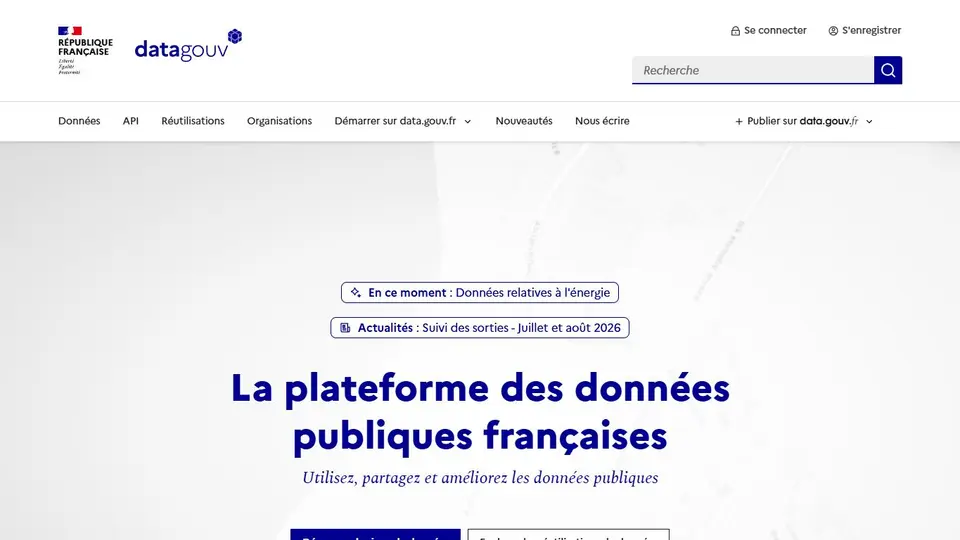
Screenshot captured on an unrecorded date. The current website may have changed.
Explore public data
Trace a dataset back to the organisation that publishes it.
Check first: Read its period, coverage and update frequency.

Compare this resource with other directory records →
A public portal: who produced this file?
- Dataset
- Read the context and identify the producer.
- Reuse
- Understand an analysis based on the data.
- Identify the publishing organisation and the file actually downloaded.
- Record period, unit, coverage and licence before calculating.
- Separate file observations from a reuse author’s interpretation.
Fictional example: a chart refers to all of France but its file covers three departments. Retain the file’s coverage; do not generalise the result.
Your useful record: Keep producer, file link, observed period, unit and coverage.
The platform includes administrations and civil society; its domain alone does not qualify every producer.
Editorial method informed by data.gouv.fr — À propos. Documentation consulted on . Examples are fictional exercises, not results from a live service test.
Connect a catalogue record to the file actually used
A dataset may group current data, history, documentation and API access.
| Element | Meaning |
|---|---|
| Dataset | Describes the published collection. |
| Resource | A particular file or access point. |
| Hosting | A resource can remain on a remote server. |
Try the reasoning
Illustrative situation. A historical and a current file are offered. Is the dataset address enough?
Read the explanation
Also retain the resource name and link, period and version. These identify the material you used.
Documentation for the table : data.gouv.fr — Publier un jeu de données · . The exercise is an editorial example.
Find the producer behind the catalogue
The platform lists datasets from administrations and civil society, together with reuse examples. Catalogue presence does not replace checking the producer and documentation.
- Producer
- Identify the organisation publishing the dataset.
- Resource
- Separate the dataset description from the file or API used.
- Reuse
- Retain licence, period, version and transformation method.
- Stated frequency
- The entered update frequency describes an intended schedule and remains indicative. Compare it with the available resource and covered period; it does not guarantee that the downloaded file already contains the next period.
- File or external link
- A resource may be hosted on the platform or link to an external server. Keep both the record link and the file link used. If downloading fails, identify the affected resource rather than concluding that the entire dataset has disappeared.
- What the score covers
- The score concerns metadata, including descriptions, documentation, update frequency, licensing and resources. It helps assess a dataset; it is not verification of every observation in a file.
Source: data.gouv.fr — Score de qualité des métadonnées · consulted on - Stated update schedule
- The declared update frequency and compliance with it are criteria. Compare that schedule with the period you need: a well-documented annual dataset can be unsuitable for a daily question.
Source: data.gouv.fr — Score de qualité des métadonnées · consulted on
Initial profile documentation
Initial profile documentation consulted on . Added details carry their own source and consultation date above.
Practical methods for this resource
Editorial selection, without website certification. Read our method.