

Wikidata
Collaborative knowledge base connecting entities, identifiers and sourced statements.
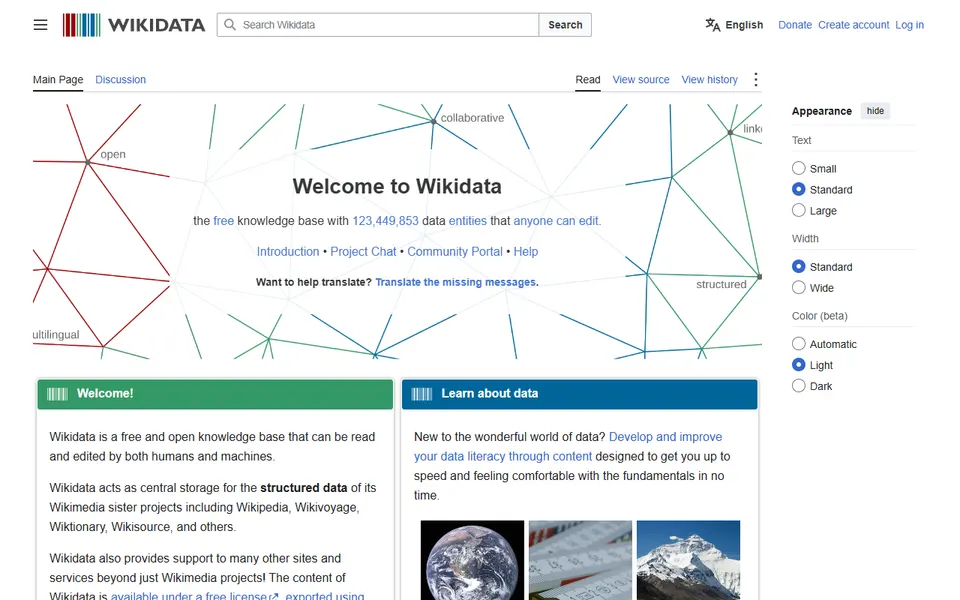
Screenshot captured on 2026-09-22. The current website may have changed.
Reuse a structured statement
Inspect the item, property, qualifiers and supporting reference before export.
Check first: Check dates and definitions; an unqualified value can refer to another context.

Compare this resource with other directory records →
Is a value enough without qualifiers and references?
- Label
- Find an item; distinguish namesakes.
- Statement
- Read property, value, qualifiers and references.
- Check that the item identifies the intended person, place or object.
- Examine the statement’s context, including its period.
- Open its reference to check what it actually establishes.
Fictional example: a staff count has a “2018” qualifier. Keep that year in your note; do not present the value as the current count.
Your useful record: Keep item identifier, property, value, qualifiers and consulted reference.
A reference attached to a statement also needs reading and context.
Editorial method informed by Wikidata — Help:Statements. Documentation consulted on . Examples are fictional exercises, not results from a live service test.
Check the statement instead of copying a label
Wikidata is a collaborative structured knowledge base. An entity contains statements with properties and values; qualifiers and references supply context to examine. The displayed label alone does not convey all this information.
- Entity
- Retain the consulted item identifier.
- Statement
- Read property, value, qualifiers and references.
- Use
- Open the cited source before repeating a sensitive fact.
- Rank and reference
- Normal, preferred and deprecated ranks organise values for a property. They do not replace a reference or reading date and method qualifiers.
- Historical value
- A correct historical value can remain useful with its time period. Do not treat it as an error merely because a newer value exists.
- Values returned by default
- When a property has preferred-rank values, views and queries using best-ranked values can omit normal-rank statements. A value missing from a simplified result may remain in the detailed statements.
Source: Wikidata — Ranking · consulted on - Several preferred values
- Several statements can share preferred rank. Rank alone is not a numerical confidence measure: compare references, qualifiers and context for each value.
Source: Wikidata — Ranking · consulted on - Rank and references
- Preferred, normal and deprecated ranks help select values and communicate consensus. Rank does not replace the reference showing where a claim comes from.
Source: Wikidata — Help:Ranking · consulted on - Historical values
- An old value that was correct for its period is not automatically deprecated. Start and end qualifiers can describe that period.
Source: Wikidata — Help:Ranking · consulted on
Are different values necessarily duplicates?
No. They may concern different dates or contexts. Compare qualifiers and references before merging.
Initial profile documentation
- Vérifier l’affirmation plutôt que copier une étiquette / Check the statement instead of copying a label ↗
- Wikidata — Rang des déclarations ↗
Initial profile documentation consulted on . Added details carry their own source and consultation date above.
Editorial selection, without website certification. Read our method.