

ORCID
Researcher identifiers and contribution records that help distinguish authors.
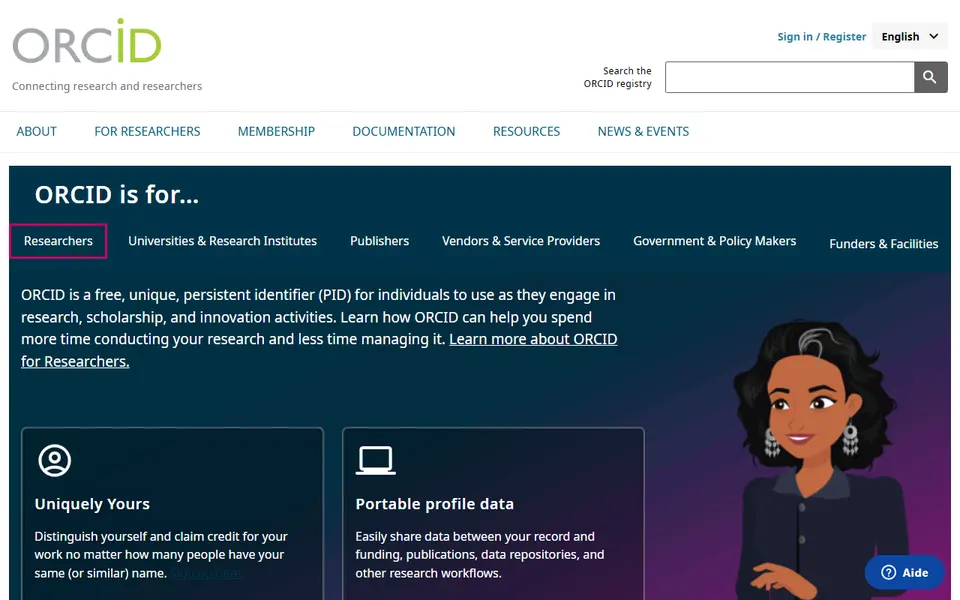
Screenshot captured on 2026-09-23. The current website may have changed.
Distinguish researchers with similar names
Match the identifier to affiliation and publications in the original record.
Check first: Profiles may be incomplete or self-reported; confirm attribution independently.

Compare this resource with other directory records →
Read a copied DOI or ORCID before opening its record →
Two authors share a name: check attribution without interpreting the number
- Identifier
- Retain leading zeros and the final check character.
- Attribution
- Compare the record with the publication’s byline.
- Record the ORCID from the publication or another explicit source.
- Check the copied identifier in the reader, then consult its record if needed.
- Match attributed works to the original document and record discrepancies.
Fictional example: two people publish as “M. Martin”. A consistent check digit cannot choose the right person. A publication explicitly linking a byline to an ORCID supplies the relationship to examine.
Your useful record: Full ORCID, its provenance and the associated publication.
The number encodes neither country, institution nor discipline.
Editorial method informed by ORCID — Identifier structure. Documentation consulted on . Examples are fictional exercises, not results from a live service test.
Distinguish authors without interpreting their identifier
An ORCID iD identifies a researcher independently of their name or affiliation. It is displayed as an https://orcid.org/ address followed by four groups of four characters. The final character is a check character. The identifier encodes no country, institution or discipline.
- Format
- Keep the full HTTPS address and leading zeros.
- Purpose
- Link a person to contributions despite shared names.
- Verification
- Compare attribution with the original publication.
- Check character
- The final character is a MOD 11-2 check digit: a number or X. A consistent digit does not confirm record assignment.
- Record visibility
- Individuals control the visibility of record information. An incomplete public record therefore does not establish that an affiliation or contribution is absent.
- Section visibility
- The iD itself is always public; other information can be visible to everyone, trusted parties, or only the holder and delegates. A sparse public record does not establish a lack of activity.
Source: ORCID — Visibility settings · consulted on - Contributing organization
- A trusted organization retains access to information it added, regardless of the selected visibility setting. Review granted permissions as well as that setting.
Source: ORCID — Visibility settings · consulted on
Can an ORCID iD reveal an affiliation?
No. The identifier contains no such information; consult the profile and relevant publication.
Initial profile documentation
- Distinguer les auteurs sans interpréter leur identifiant / Distinguish authors without interpreting their identifier ↗
- ORCID — Identifier structure ↗
- ORCID — Services aux chercheurs ↗
Initial profile documentation consulted on . Added details carry their own source and consultation date above.
Editorial selection, without website certification. Read our method.