

Europeana
Digitised cultural objects from libraries, museums and archives across Europe.
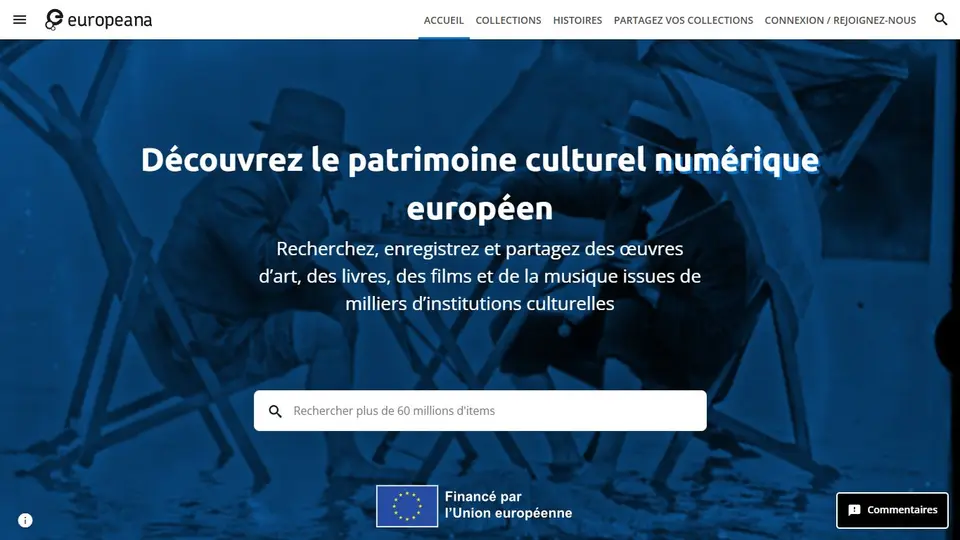
Screenshot captured on an unrecorded date. The current website may have changed.
Explore European heritage
Compare digitised objects from contributing cultural institutions.
Check first: Open the holding institution’s record for reuse rights.

Compare this resource with other directory records →
Keep a cultural object with its provenance
- Europeana record
- Identify the discovered object.
- Source institution
- Recover documentary context.
- Open the record for the object of interest.
- Read its rights statement before planning reuse.
- Keep the record and source institution in your notebook.
Fictional example: a student compares two portraits of the same person. He retains both records and source institutions. His report describes their different origins; visual resemblance does not make them a single file with identical rights.
Your useful record: Object, source institution, rights statement and consultation date.
Using metadata does not settle rights to the cultural file itself.
Editorial method informed by Europeana — Reusing digital cultural heritage. Documentation consulted on . Examples are fictional exercises, not results from a live service test.
Separate record rights from file rights
Europeana metadata are under CC0; this alone does not determine rights in the digital object.
| Element | Meaning |
|---|---|
| Record | Bibliographic or descriptive information. |
| Digital object | Image, recording or other file: inspect its rights statement. |
| Missing rights | Return to the providing institution’s website. |
| Providing institution | It supplies the object and its documentary context; retain the link to its record. |
| Record and transcription | The terms distinguish content, metadata and enrichments: appearing together does not make their rights identical. |
Try the reasoning
Illustrative situation. An openly reusable record describes a poster. Can you automatically reproduce its image?
Read the explanation
No. Record the image’s rights and institution’s conditions, then retain creator, identifier and credit with your project.
Documentation for the table : Europeana — Terms of Use · . The exercise is an editorial example.
Separate metadata rights and object rights
Europeana states that its metadata is published under CC0. Digital objects carry their own rights information; consult the provider when that information is absent.
- Metadata
- CC0 applies to the descriptive data presented.
- Digital object
- Read the rights statement for the image, audio or file.
- Provenance
- Keep the institution link and useful attribution.
- From result to provider
- Open the contributing institution’s item record to find its description, available file and corresponding rights information.
- Prepare a credit
- Retain title, identified creator, institution, item link and rights statement; a result thumbnail does not always supply these details.
- Object-level rights
- Each object record presents a rights statement for examining reuse.
Source: Europeana — Reusing digital cultural heritage · consulted on - Metadata at scale
- Europeana APIs enable use of machine-readable metadata.
Source: Europeana — Reusing digital cultural heritage · consulted on
Initial profile documentation
Initial profile documentation consulted on . Added details carry their own source and consultation date above.
Editorial selection, without website certification. Read our method.